I had to check the date on my last post to figure out when I posted–I didn't realize it had been so long. I just couldn't cope with the weather. For the last two weeks it's been the kind of weather that keeps me in the house (heat waves) or keeps me from bringing my camera out (rain), and sometimes both. Last week we had a heat wave, with thunderstorms in the evening. It's been a frustrating couple of weeks, weather-wise. But today there was a break in the rain, and it was cool outside (68ºF when I went for my walk–quite a contrast with Monday's 90ºF), so I took my camera for a walk.
For most of the walk it felt like a waste of effort to be carrying the camera, because I didn't see a lot of bugs–it had rained in the morning, and was overcast and chilly, and the bugs didn't want to be out and about, I suppose. But then I found a bug I had never seen before, which you know is rare for me these days, and that made it worth it. I almost didn't bother to try to take its picture, because it didn't look like much at first (and I thought it might be a moth fly, and they are very uncooperative, often not worth the effort to try to get a picture), and the lighting was bad with the overcast sky, but I made the effort, and it cooperated, and so here is Backyard Bug of the Day:

According to the internet, this is Anotia uhleri, a species of derbid planthopper. When I was looking at it through my camera, I was mystified, with no idea what it was. Some kind of hopper was something I considered, but also I thought it might be a type of fly, or even a strange moth.
Other than that, there were basically two themes to today's bug walk. First, Ailanthus webworm moths:


I think I saw more ailanthus webworm moths than I saw in the previous decade of bug photography combined.

Goldenrod is just generally popular, but even in this shot where I was taking an establishing shot of a fly, notice all the ailanthus webworm moths on the flowers.


These various pictures were taken all over our property, in the field, along paths, in meadows in the woods. Of course, what all of these locations have in common are ailanthus trees. (aka tree of heaven, or my name for it, stinky tree).
Ailanthus is the host plant for the ailanthus webworm moth:


... in addition to caterpillars you can also find multiple chrysalides in the webs.

Like I said, goldenrod is popular with lots of insects, including some that don't feed on the flowers, but on the things that feed on the flowers. After all, if you want to eat insect, a great place to hang out is the place where the insects go to eat. Just ask this jagged ambush bug nymph:


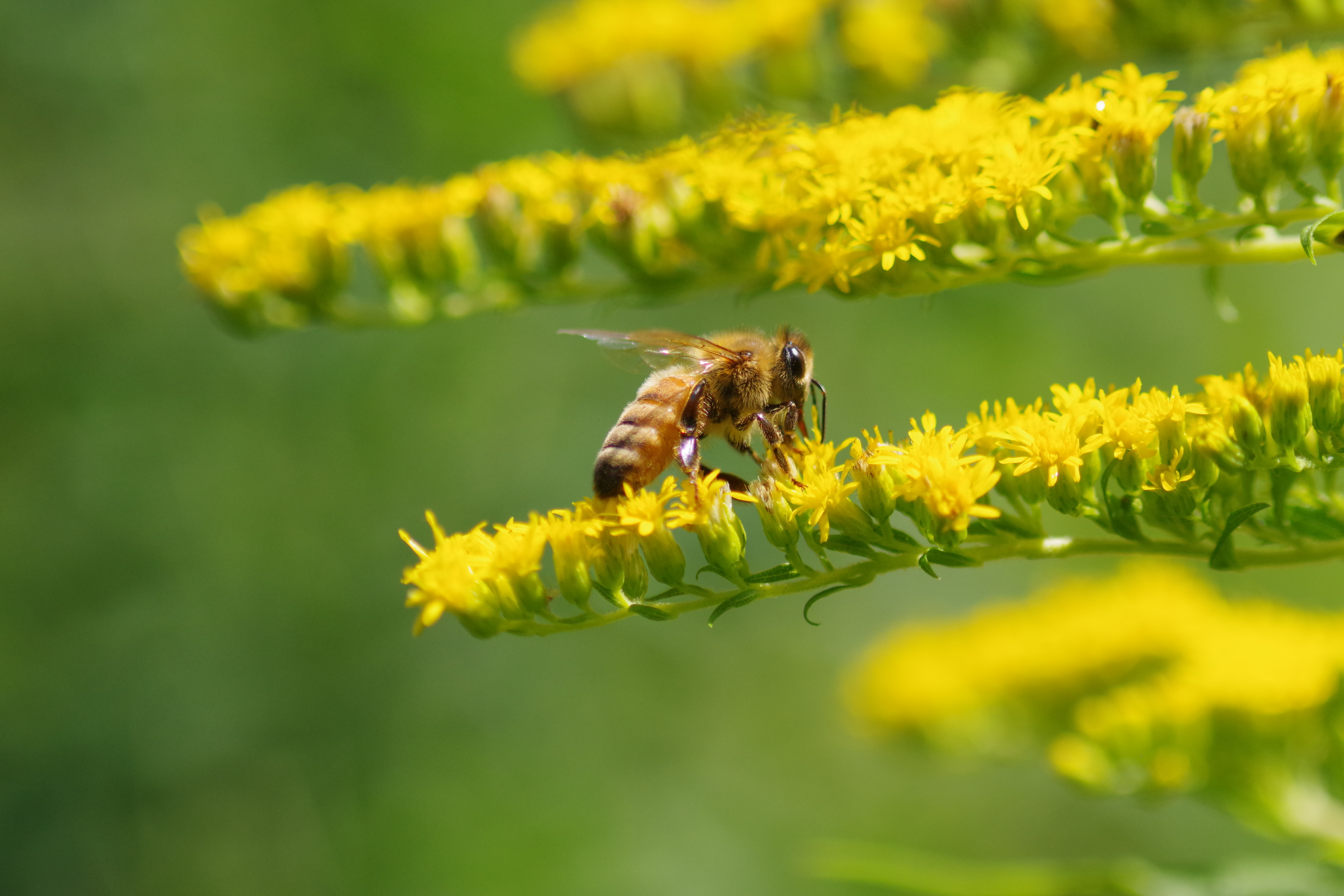
I didn't see a lot of bees today, because they don't really love this yucky, rainy weather. But they generally love goldenrod.

As do various species of looper caterpillars.
The other theme for the day was crickets and katydids:

I found this cricket near my back door when I got home from running errands. This cricket is why I brought my camera out in the first place today. I saw a lot of crickets and katydids today.
Then in a patch of weedy grass (or rather, invasive species grass) in a clearing in the woods my husband noticed a bunch of insects, which turned out to be a LOT of crickets and katydids.

The grass is thick and tall, and leafy, and the crickets and katydids had lots of hiding places, so they were hard to spot, and easy to lose when they wanted to be lost. So I didn't get many pictures.

And the pictures mostly look like this.


This cricket is missing a hind leg. It can still get around, though.
It's a pity I didn't see any grasshoppers today. That patch of grass is perfect grasshopper habitat, and then I could have had all three odonata types.
So, what else did I see on my walk today...

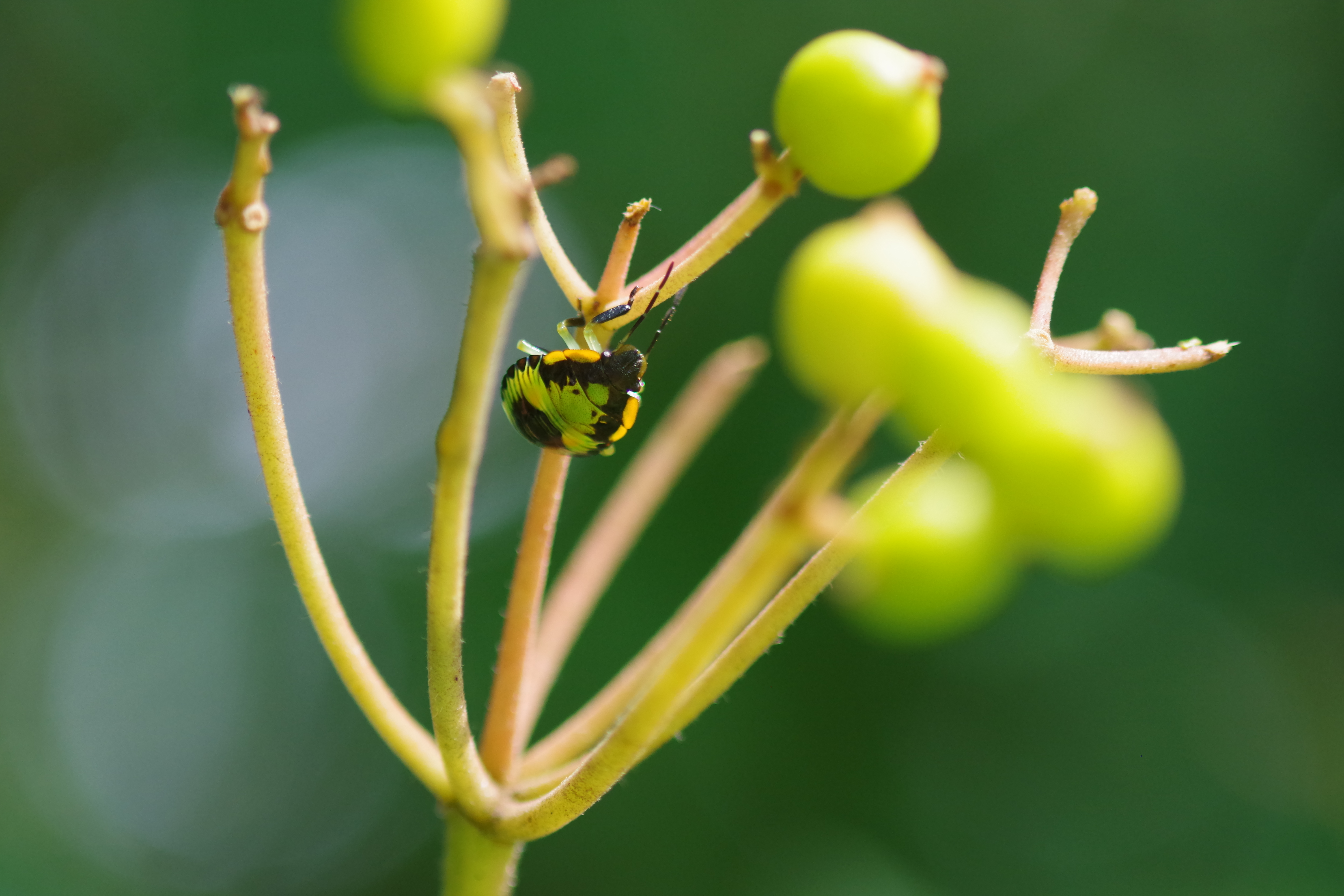
Nymph of some kind of hemiptera. Leaf footed bug, probably. It's big for a nymph, it's probably going to become an adult at its next moult.

These beetle larvae are still feeding on the cucamelon leaves in my garden...

... and the chrysalis on a bean leaf has turned a darker color, so that is probably going to eclose soon.

Tiny moth on grape leaf

This squirrel was noisily gnawing on a butternut.

People are so afraid of these wasps, but this one was quite placid...

... and when I startled it by breaking of a twig to get a closer look, it just scurried around to the back side of the leaf and peeked over at me. How could you not love that little face?

Cicada exuvia–the shed skin left behind when the nymph molted to become an adult.

Scorpionfly. I think this is a female; the males have a longer, curlier abdomen/tail. I saw a couple of these today.

Milkweed tussock moth caterpillars. Soon these will all decide that they've had enough togetherness and wander off alone. I have had many broods of these on the milkweed near my back porch this year, sometimes finding them communally like this, and sometimes finding just one caterpillar off on its own.
A couple of weeks ago I noticed a colony (I don't know if that's the right word) of beech blight aphids on a branch of a beech tree. It's the first and only place I have seen them this year. They were all over the beech trees in the woods last year. From what I have read, they periodically have huge population booms for a couple of years, and that is obviously what happened last year, and to a smaller extent the year before. I don't know if the reason I am not seeing them this year is because their boom is over, or because the beech trees are suffering from beech leaf disease, and that is somehow affecting the aphids. I hope the former, but if the beech trees die, inevitably that will affect these aphids:

They are not all as fuzzy as they were when I found them a couple of weeks ago, and they were not as active; another common name for these insects is boogie woogie aphids, because when they feel threatened they wave their fuzzy butts around, which makes it look like this is a giant insect dance party. These didn't feel much like dancing today, which could be because of the grim weather.

Here you can see a few of them excreting drops of honeydew. These insects are unpopular with people who have beech trees in their yards, because when you get these population booms, collectively they excrete a lot of honeydew, which is basically sugar water, and it covers anything below the colony with sticky fluid which then causes a black fungus to grow. I admit, it's unsightly. But kind of interesting.


Monarch butterfly egg! I saw this a couple of days ago on a walk without my camera, and have been waiting for a chance to get a better look at it to be sure it was a monarch egg. It has changed color in the interim, which means either it is going to hatch soon (the dark spot is probably the caterpillar's head), or it has been infected with something (which is possible because there's more dark spots than just the one that is probably the caterpillar's head. I hope it hatches and thrives. None of the other monarch caterpillars I have seen this year have made it past the earliest instars. I have seen a lot of milkweed leaves with leaf damage such as would be made by a first instar monarch, but nothing beyond that. It's discouraging. So I hope this one defies the odds and becomes a butterfly.
The Bad Part of My Bug Walk:

The invasive ailanthus tree is not just host to the ailanthus webworm moth, it is also the favored host of the horrible spotted lanternfly. This one is on a goldenrod plant, but this particular clearing has a lot of ailanthus sapplings–I cut them down, and they grow back.

I was thinking happily the other day that I haven't seen any of these in a couple of weeks, but then I realized that I also haven't been out in my backyard as much in the last couple of weeks, between going away for a few days, and the bad weather...

So now there are adult spotted lanternflies, in addition to the nymphs. I found several of each, nymphs and adults. I tried catching them with the bottle method you see online, and found that it doesn't work as well on skinny sapplings as it purportedly does on bigger tree trunks. But I caught a few. It's too bad they are so harmful, because they are cool looking bugs. I don't know where they get the lanternfly part of their name, but you can see where the spotted part comes in.
I was going to add all the pictures I took on my phone in the last couple of weeks on walks without my camera, but it's late, and I'm tired... If I feel motivated tomorrow maybe I'll just do a post of all of those...
Arachnid Appreciation:
.
.
.
.
.
.
.
.
.
.
.
.

This nursery web spider has been hanging out on this milkweed plant for at least a week.

I walked into this spined micrathena's web, but fortunately was able to back out without breaking it.

A couple of days ago I noticed what I thought was a monarch butterfly egg on the underside of a milkweed leaf, and I have been wanting to bring my camera out for days to be able to look at it closer with my macro lens to find out of that's what it was. Today I had the chance, and was not very happy to find a spider on the same leaf. I didn't want the caterpillar to hatch and immediately get eaten by the spider. So, I relocated the spider to another plant nearby. None of the monarch caterpillars I have seen this year have made it past the early instars. I would like this one to have a chance of lasting more than a minute.

Uncooperative spider...