Wednesday, August 25, 2021

Night Lights

 Firefly season in my backyard ended about a month ago, but last week I thought I saw one when I was out on the back porch for sky time. I wasn't sure if that's what I saw, and it was a very yellow light, unlike the usual greenish glow of the fireflies I see here. Then tonight I saw one (or more? Hard to tell) again, definitely yellow, and this time my husband saw it too. So I am now wondering if I have a new (to me and my backyard) species of firefly. I hope so. I only saw it flash a couple of times, and didn't get a chance to try to see it up close. I'll have to keep an eye out for it again.

It's been hot and disgustingly humid, so I didn't even want to go outside today, but I did, because even when I don't want to go outside I want to go outside. I definitely didn't want to do a bug walk, so I didn't bring my camera on my woods walk. I soon regretted it, as I saw quite a few cool bugs, but I finally got to a point when I thought I would regret it if I didn't walk back to the house and get it. This added about a quarter of a mile, at least, to my walk today, but hey, exercise is good for your heart. See, there is a clearing in the woods with goldenrod along the sides of the path, and I found a goldenrod plant that had four different species of insects on it, none of them bees or wasps. I was taking a chance by walking all the way back for my camera, hoping that at least one particular bug would still be there when I got back, and I got really lucky–3 of them were. One was a species that I saw about a week or so ago, which was the first time I have seen it in a couple of years, so I really wanted to get a picture of it. 

So, here it is, Backyard Co-Bug of the Day #1:

I think this should be called a moose beetle or a Bullwinkle beetle, but it is a species of wedge-shaped beetle called Macrosiagon limbatum. This is a male. You can tell by a few things, but primarily the giant tv antennae on its head. I wonder how many channels he can pick up with those things; when we got rid of our cable and tried to use an antenna we didn't have much luck.


Also on that plant was a related species:

Tumbling flower beetle. I have a rule on this blog that if I ever get a really good picture of a tumbling flower beetle it gets to be Backyard Bug of the Day. This is pretty close, but not good enough. I am an idealist.
I am shocked that I got as many pictures as I did–usually they live up to their name and tumble off the plants before I can get much. Which, by the way, is a popular technique with many beetles, so I don't know why these got the name.

And another beetle on that plant:

Spotted cucumber beetle

Another insect fond of goldenrod is Backyard Co-Bug of the Day #2:

Ailanthus webworm moth

Other Bugs:

Katydid on goldenrod. There was another species of katydid only inches away, but it jumped out of sight before I could take a picture.

Tree cricket

Honey bee on goldenrod

I couldn't find the monarch caterpillar, but this milkweed tussock moth caterpillar showed up on the plant where I saw the monarch the other day.

Katydid (female) that I found while harvesting cucamelons in the garden.

Progress report on the ladybeetles:

One has decided to pupate on the wall of the back porch...

... another will be joining it soon...

And while I was putting my shoes on for my second woods walk, I looked up at the back porch tree and saw that one has finished pupating...

... and was eclosing as an adult!

We left on our walk, which was a short one, and by the time we came back, it was all the way out. It hasn't developed its full color yet, as is often the case when insects either molt or emerge from pupation.

Today I saw quite a few really interesting bugs that I was unable to get pictures of. And then, there was this one:

This moth fluttered into the beam of my flashlight, and I could see that it had a cool underwing pattern. I followed it with the light to see if it would land, and it seemed to zoom past me... but it had actually landed on the side of my leg. It is tricky to take a picture of the side of your own leg with a cellphone while holding a flashlight.

You can just barely see the orange and black stripes of the underwing pattern. Strangely, one of the other insects that got away when I tried to photograph it today was another species of moth that looks very different with its wings closed, but has a very similar underwing pattern.

Also seen in the woods today:

There is a family of deer, a doe and two fawns–one from this year, and one I think that is probably a year old–that I encounter on my walks occasionally. I always frighten them away before I notice them, so what I see is them bounding through the woods. Today I quietly followed them, and got a few shots, none of them good... Here you can see two deer...

... and you can just barely see a fawn fleeing when they decided to run off again.

Today I think I must have set a record for the number of frogs I saw on my walk. It had to be around twenty, from at least 4 different species. They were more skittish than usual; usually they jump into the stream or off the path when I am almost upon them, but today I saw them splashing into the water when I was about twenty feet away. Yesterday and earlier in the week there were a few really complacent ones who let me get close, but not today. Interesting thing, though, is that I have had an answer to one of my longtime frog questions this week, and particularly today. I have always wondered how precise frogs are in their leaps. Sometimes I see them leap quite long distances, jumps of a couple of feet in length, many times their body lengths. And I have wondered whether they were calculating where they wanted to land, and trajectories, and all that, or if it was just a leap of faith. Well twice today, and once earlier in the week, I saw frogs jump and crash into things, dropping into the water or onto the ground. There are sticks and plants along the edge of the stream, and frogs leaping toward the water have bonked into them, clearly not what they intended to do.

Anyway, here's the two I got shots of today:

This is the only one that landed in the stream where I could still see it and photograph it, and as soon as my shutter clicked it darted away.

Wood frog. I only see these on land.

Yesterday I found a lot of a new fungus that has just sprung up:

This is the first one I saw, and I was really puzzled by it. It looks like an egg with two yolks, and slimy-looking goo with these two orange orbs in it. There was no egg shell, though. But later I found several more, with more orbs per goo pile. I eagerly await the development of these.

Arachnid Appreciation:

.

.

.

.

.

.

.

.

.

.

.

.

Bowl and doily spider with prey

Female spined micrathena

I have been trying to figure out for several years what these next spiders are, to no avail. I still don't have a spider guide, and none of my insect guides really cover spiders well (because they're not insects). They LOOK like a smaller version of a spined micrathena, so I thought maybe they were males, but I looked up what male spined micrathenas look like, and it's not this. Today, I think I finally found out what they are: white micrathenas:

Very hard to tell from this angle, but...

They look related to spined micrathenas, just not spiky. Well, as it turns out, they are related, in the same genus. They also have the same annoying habit of building their webs at face level across my walking paths. Fortunately, today I noticed all of them before walking through them.


Sunday, August 22, 2021

The Cameras of My Past

 My first camera was a gift from my parents when I "graduated" from elementary school. It was a 110 camera, and I was excited to have a camera of my own. It was very easy to use, just pop the film in, close the camera, and you're ready to take pictures. There was nothing electronic, or even electric. It was "focus free," which means it didn't really focus on anything in particular, but was just sort of in focus in general. The film was advanced by turning a wheel. There was one button, the shutter. It really only worked well in bright sunlight. It could take flash cubes, but they were expensive and I think flashed four times before needing to be replaced. I think I used the one that came with the camera and thenceforth never took another picture in low light with that camera. Basically, it was good for taking vacation snapshots, and pictures of your friends. I don't remember how I went about getting more film, or getting my pictures developed. I didn't take a LOT of pictures, because of needing film and developing. Also, I didn't have a lot to take pictures of. I do remember, though, that that was the beginning of my desire to take pictures of bugs. I never did, because there was a specific bug I wanted to take a picture of, and, well, that camera was not meant for such things. There were these tiny, blue butterflies that I would see once in a while, and I desperately wanted to take a picture of one, because I found them enchanting. Their tiny size and pretty color were wonderful to me, and there several occasions when I tried to take pictures of them with my 110 camera. I didn't see them very often, however, living in a suburban neighborhood where every house was surrounded by the ecological wasteland that is the American lawn. But aside from rarely seeing these butterflies, I had not chance at getting a picture of one because 1) my 110 camera wasn't really capable of such a shot, and 2) it's very difficult to get close to one of those butterflies. I will add, by the way, that I don't know what species they were, and if I was even seeing the same species all the time; now, decades later, I know that there are several possible species I could have been seeing. But I knew virtually nothing about insects back then. Anyway, I have had many cameras since then, moving up in quality and capability, and with each new camera I tried to take pictures of those tiny, blue butterflies. Most of my ensuing cameras were also not up to the task, and it was still very difficult to get close to them. And for a LOT of those cameras, missed shots or bad shots meant wasted film. But eventually I not only moved into digital cameras, which don't require film, and allow me to take as many pictures as I want, but a macro lens, which is great for taking pictures of insects. IF you can get close to them. And that has remained the problem with all of these tiny butterfly species. Yes, at times I have done it. I have taken decent, close-up pictures of many species of tiny butterflies, some of them even tiny blue ones that could be the same ones I have been trying to photograph since I was 11 years old. But oh, how difficult it is.

I suppose you probably think that this is all leading up to me showing you the amazing photo I took today of a tiny, blue butterfly, but it's not. Because I didn't get any good pictures of tiny, blue butterflies today. I got these:

I don't think this is even blue; I didn't get close enough to see. However, when we walked by this stand of plants at the beginning of our walk there were four of five tiny butterflies here, and they looked blue while they were flying. This might have blue on the dorsal side of its wings. It's a long story, but I didn't have my camera on the start of the walk, but when I came back, there were still butterflies here.

I don't know what this plant is; I thought it was wild lettuce, but now I don't think so. The interesting thing is that it is very attractive to these tiny butterflies, as I have seen them here for the last several days, but the flowers are not in bloom. Some of them have gone to seed, and some of them have seed heads that have not opened yet. They seem to be very attracted to the ones that are not open yet. I wouldn't think that they would have nectar, but maybe they do? I should mention that this is a pretty big patch of these plants, which are taller than I am, and of course the butterflies only landed on the plants that were nowhere near where I was standing.

This one is a species of hairstreak.

Bonus points if you can see the wasp in this picture as well as the butterfly.


A bug walk did not seem to be in the realm of possibility for today because we were supposed to have a hurricane. Hurricane Henri appeared to be making a beeline for us. We worked very hard yesterday at battening down the hatches and preparing for violent weather and power outages. But Henri had powered down a bit by the time in came ashore, and after a bit of rain and some strong winds in the morning it just petered out by mid-afternoon. Once it became clear that we weren't just in the calm eye of the storm, when the rain ended, the winds died down, and the sun peeked through, we decided to go for a walk in the woods. I didn't bring my camera, in case it started to rain, and because it was incredibly humid, which means I would just sweat all over it, so naturally I saw a lot of bugs (including the aforementioned butterflies. And a LOT of frogs). Ah, well, I was resigned to missing out on all of those photo ops, but when we were almost back to the house I saw a caterpillar, one that I have not seen yet this year (and speaking of which, I have hardly seen ANY caterpillars this year. I know I haven't been doing regular bug walks, but I feel like I should still be seeing them when I am out there), so I went and got my camera. The caterpillar was on the move, but I figured I would be able to find it when I got there with the camera... and I was wrong. I couldn't find it anywhere. But since I was out there, and had the camera, I did walk around a bit, and went back to the patch above to see if there were butterflies (yes, as you can see, but not as many). And then, when I got back to my backyard I walked by the milkweed patch, not expecting to find anything but always hopeful and weirdly optimistic, and I found the Backyard Bug of the Day:

Monarch caterpillar! Yes, I know, I have already had a monarch caterpillar as BBotD, but that was a newly hatched, first instar caterpillar, and this one is a late instar (probably not the last, but close). This is the first one I have seen this year that has made it past its first couple of days after hatching, and a LOT of the eggs I saw never hatched at all. Also, this is my blog, I can break my own rules if I want, and I am so happy to have found this caterpillar that it is Backyard Bug of the Day. I am still not holding my breath that it will be able to mature into a butterfly, but it is the most successful monarch caterpillar in my backyard so far this year. Well done, little caterpillar!

Yeesh. I have written so much in this post... time for just pictures... Other Bugs:

Dragonfly

Oh, speaking of knowing nothing about bugs when I was a kid... I am re-reading a book that I read many times when I was a kid, Henry Reed's Journey, by Keith Robertson.  The main character in the book, Henry Reed, is a smart kid, and he plans to be a naturalist when he grows up, and reads a lot about animals and nature. Anyway, the part of the book I just read while waiting for the dragonfly picture above to load said this: "I like bugs if they don't bite or sting, and the hundreds of different kinds are just as interesting as birds and a lot easier to catch." Yes, the "hundreds of different kinds." Hundreds. No wonder I had no idea when I was younger that there were SO MANY kinds of insects. Not only did I live in an ecological wasteland, and therefore extremely limited in the number of species I actually saw, but I was reading books in which characters who claimed to know a lot about nature said there were hundreds of kinds of bugs. So I had no idea there were over 20,000 species of bees. Or 925,000 identified species of insects. Or potentially 1.5 MILLION species of beetles. Children's literature misinformed me. (And a couple of pages later it said, "She argued that if a worm or a grub in a cocoon can change overnight into a butterfly..." No. Just no).

Anyway, I also had no idea that there was more than one species of cricket. I had no idea this existed:

Bush cricket of some kind.

Long-legged fly

I don't know what bees do during a hurricane; I assume the ones that have a hive go there, but there are solitary bees that I don't think have that kind of shelter. At any rate, when I saw bees out pollinating during our walk I took that as a sign that the storm was truly over.


I do know that in some inclement weather bumblebees just hang onto plants and ride it out. But in a severe storm? I don't know if they would do that.

I know this is a terrible picture (it was still pretty breezy when I was out with my camera), but I am sharing it because I think it's funny that I didn't notice the very obvious second bug when I took it. I can't tell if it's on the back of the bee or on the plant beyond it. Also, I like the little droplet of rain on the bee's back. A tiny remnant of the hurricane.

The only spider I saw today was the spined micrathena that has had a web across the path in the woods for the last week or so. I didn't have my camera, so I don't have a picture, but I did see her today. I was curious whether her web would be there today, and it was not, but she was sheltering under a leaf on one of the trees she has been anchoring her web to. I don't know if the storm wrecked her web, or if she took it down (ate it) because of the storm, and then just rode out the hurricane under the leaf. I am curious to see if she has a new web tomorrow.


Saturday, August 21, 2021

Cycling

 I only have one picture to share today, because I didn't get to do a bug walk, what with preparing for a hurricane and all. Yet again I spotted something while I was sitting on the back porch steps, and it's the perfect addition to what has been a theme this week, The Life Cycle of the Lady Beetle:

This lady beetle larva is getting ready to pupate! When I found it, it was hanging upside down with its back end stuck to the leaf. Of course it "snapped" down when I disturbed it, so I didn't get a shot of it hanging, but you get the idea. So, this week we saw lady beetle eggs, lady beetle hatchlings, multiple instars of lady beetle larvae, lady beetle larvae beginning the pupation process (there were several like this), a lady beetle pupa, and lady beetle adults!


Friday, August 20, 2021

Snap!

A few days ago I was ruing the fact that there were no lady beetle pupae on the back porch tree, because I would have had the entire life cycle of lady beetles on the tree. I thought, however, that there might be one soon, because of the size of some of the larvae. And today...

A lady beetle pupa. It already looks more like an adult lady beetle than the larva does.


The thing I have always found most interesting about lady beetle larvae is that they can move. They are anchored in one spot, but the pupa can be straight up/down like the top picture, or it can lay down against the surface where it is attached. I have always wondered why they do that. I assumed it was defensive, but I couldn't really see how it helps. Being anchored in one spot, they can't flee, and they have no mouth for biting, no stinger (because they don't have stingers anyway in any stage), and not even any appendages. So what is the point in being able to move at all? Well, coincidentally, I read this week (or maybe it was last week, I have lost my sense of time) that what they are doing is snapping down on top of anything that tries to annoy them (from that direction, anyway), and that they can actually crush an insect this way. That seems like a pretty good defense, even if it only works in one direction. As you can guess, when I disturbed the leaf where it is attached, it bent down like this. I came away unscathed.

I didn't see any adult lady beetles, or eggs, but there are currently a lot of lady beetle larvae on the back porch tree, of varying sizes:

These two look just about ready to pupate.

Not that you can tell, but this one is much smaller.

This one has recently molted, I think, with its exuvia on the lower right of the picture.

Another one that has recently molted, with its exuvia

Backyard Bug of the Day:

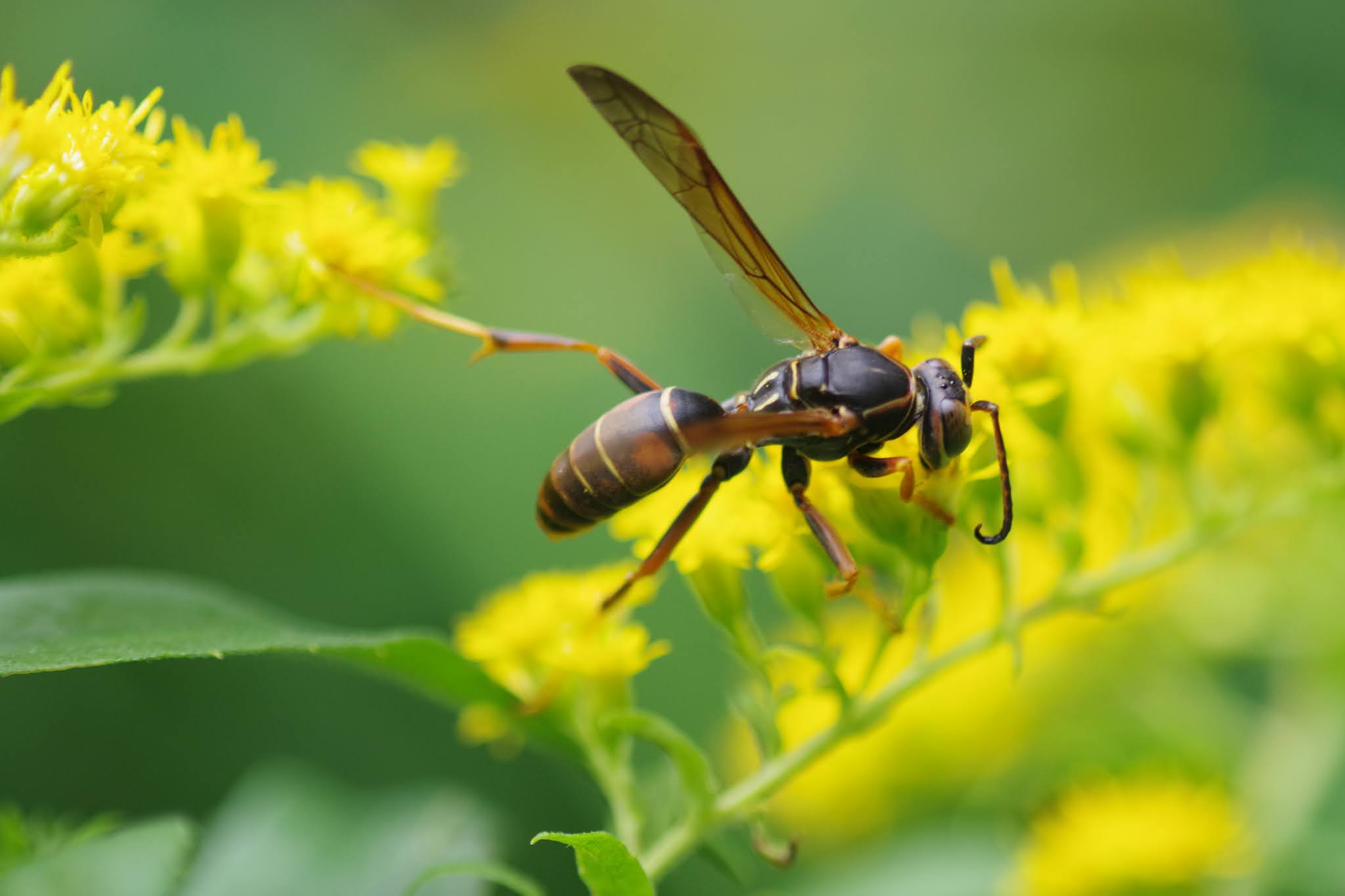
Wasp. I think it's a male, and I read something about how this is the time of year the males are pushed out of the nest because they don't really do anything useful at this time of year. So it will spend the rest of its life (which will last until the first frost), feeding on nectar. The abundance of goldenrod now is just what they need.


The wasp was not alone; the goldenrod is feeding a lot of insects these days:

You have to look carefully at these next several shots; there are a lot of insects in there, mostly bees and wasps, but also a hoverfly.


And, of course, there must be predators where there is prey. Jagged ambush bug.

Assassin bug nymph

I saw a lot of katydids today, and managed to get pictures of two of them:

This one is a female–note the ovipositor sticking out at the back.


Male, with clasping organs instead of an ovipositor

A hoverfly doing what hoverflies do:


Well, male hoverflies do this as part of their mating ritual. I don't know if the females do it.

Three crickets in descending order of cooperativeness:


Leafhoppers

Yesterday I went on my walk in the woods without my camera, and soon regretted it because I saw a lot of bugs. My husband suggested I could go back for it, but we didn't really have a lot of time, so we just continued on. I remember ruefully thinking that it wasn't likely that the bugs would still be there if I went back for my camera anyway...

... but this bug was in exactly the same place today as it was yesterday. This is a green stinkbug nymph, and based on the size of it, very soon to become an adult.

I found another one, too.

Assassin bug

Bee on a fern

This is one of the creepiest insects in the backyard. I am sure you are wondering why I am even calling it an insect, because it doesn't look like one. This is a larva of a syrphid fly, or hover fly. The adult hover flies feed on flower pollen, but in their larval stage they eat aphids. I found this one on the back porch tree. They are really bizarre creatures, and I am never sure which end is even the mouth.

Arachnid Appreciation:

.

.

.

.

.

.

.

.

.

.

.

.

Harvestman

Goldenrod spider, I think:


Nursery web spider

This spined micrathena spider has had her web across one of our paths for the last few days. It's really freaking annoying: