Time for an update on the monarch chrysalis in my dining room. As you may recall, I have been concerned about what might be inside the chrysalis ever since it formed, because of the dark lines on it. I have never seen one like that, and a cursory search of images of monarch chrysalides didn't turn up any like that, so I though that either the caterpillar had a parasite, and would not turn into a butterfly, or it had an infection, and would not turn into a butterfly. Yesterday was 11 days since the chrysalis formed, and that was when I was expecting it to eclose if it was going to do so, but it showed no signs of doing so. The day or night before a monarch ecloses the chrysalis appears to change color from green to black and orange, but in reality the chrysalis case is clear, and it is what is inside that is changing color. The black and orange you see at that point is actually the butterfly. If it was going to eclose on Wednesday that change should have started on Tuesday, but it didn't. And then on Wednesday... it didn't. Then today, for much of the day it continued as it had been, but when I came in from my bug walk, it looked like this:

Something dark inside... at that point I was thinking that something other than a butterfly has been growing in here for the last 12 days...
... but this is how it looks now. The butterfly wing is visible. I am still concerned about the dark lines, but it kind of seems like that part is just more transparent, perhaps? I don't know. I still don't know if the butterfly will make it out of the chrysalis–sometimes they form, but whatever is wrong with them keeps them from properly eclosing. Or they just don't come out at all. I guess the answer will reveal itself tomorrow, along with whether this is really a female butterfly, as it appears from the signs I looked up.
Backyard Birds of the Day:
I can't tell what these are. One of them was putting up quite a fuss, calling constantly while they kettled.
Backyard Bug of the Day:
Some kind of Hemiptera. I am going to guess predatory.
Other Bugs:
Once again the autumn joy sedum was bereft of bees when I went out to do my bug walk, but I did spot this dragonfly.
It hung around for quite a while, moving from plant to plant. I know it was not feeding on the flowers, but I don't know the reason for its changes in location.
I did find this one tiny wasp on the flowers:
And then in the evening I found one bumblebee there. Notice that the flowers have changed color; they were a pale pink, and now they are much darker.
Today most of the bug action was back in the rock garden. It's interesting, because there isn't much blooming there. Two individual flowers, to be exact. Usually the really buggy areas of the backyard are the blooming ones, but that depends on what the bugs eat, and the bugs in the rock garden aren't nectar feeders for the most part. In fact, I could call it my Orthoptera garden:
There are three kinds of Orthoptera: grasshoppers...
... crickets...
... and katydids. As you can see, I found all three in the rock garden today.
And a couple of Hemiptera:
Leaf hopper
Leaf hopper
But mostly Orthoptera:
Multiple species of crickets
Terrible picture of this katydid, but what I noticed when I looked at it on the computer is there is something on the leaf that looks like the weird thing on the mum plant that I have been observing for the last couple of weeks as it does nothing.
Cricket and two grasshoppers. I just missed getting a shot of a katydid on this rock, too (but not while the cricket was there. It would have been awesome to have all three kinds of Orthoptera in one picture!).
Missing a hind leg.
In this shot there are four grasshoppers, plus a fly and an ant. And who knows how many other things in the vegetation. I can't tell if it's in this shot, but there was a wasp near the top of these rocks. Also, at one point one of these grasshoppers crept up on another and jumped on it, leading to a scuffle.
And then... there are ants. And I would guess that is the hind leg of a cricket.
The ants were busy today.
Assassin bug
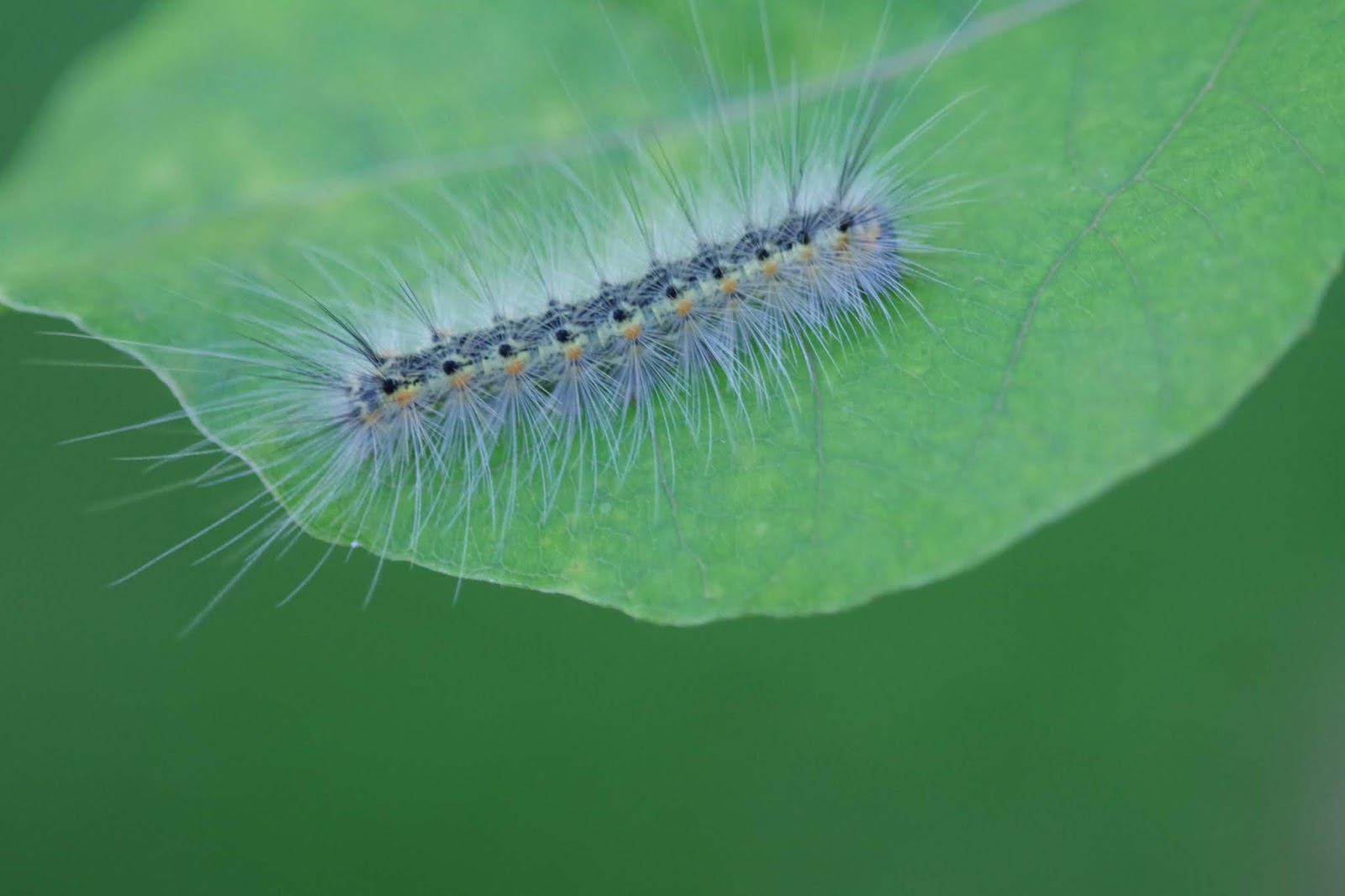
And of course, banded tussock moth caterpillars:
And a white marked tussock moth caterpillar
Fall webworm
Robber fly
Honeybee and ambush bug
Closer look at the ambush bug
Wasp
Tree cricket
Sweat bee
Arachnid Appreciation:
.
.
.
.
.
.
.
.
.
.
.
.
Harvestman
All of the spiders I saw today were in the rock garden.
This spider was prey to a parasitoid wasp.
It's very hard to see what's going on here, but the wasp dropped the spider and flew away for a few seconds (possibly because I got too close) and then an ant came out of the greenery and tried to drag away the spider.
The arrow points out the ant. The wasp was stronger, though, and regained possession of its prey.
The funnel web spider
Orb weaver